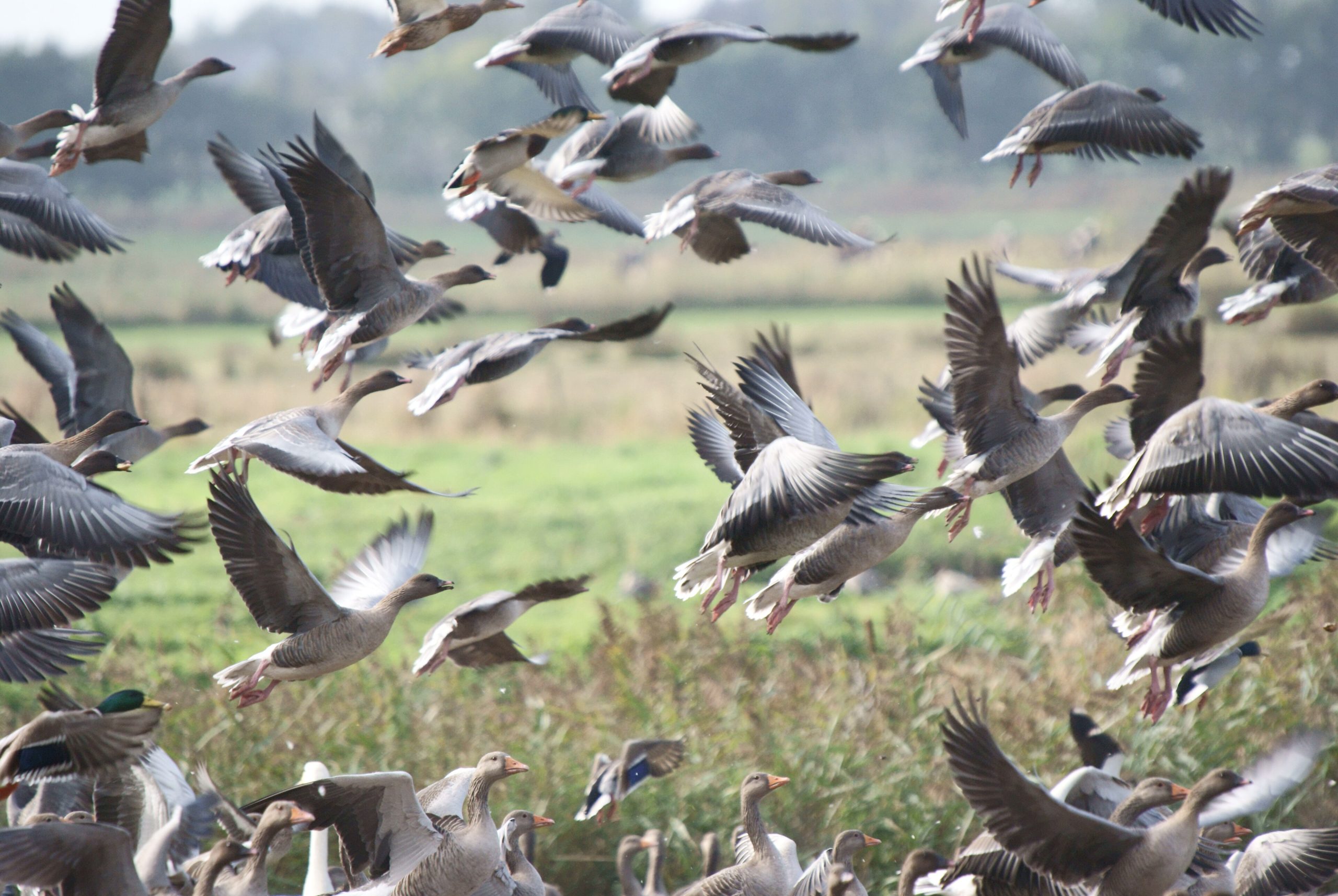
This coast is famous for its birds. The reserves from Cley to Titchwell have reedbeds, lagoons and grazing marsh with birds all year round, thousands more pass through on migration in spring and autumn, and in winter tens of thousands of pink-footed geese fly in from Iceland and Greenland. Out on Blakeney Point, England’s largest grey seal colony is a short boat trip away.
Good to know
- The geese leave their roosts at first light to feed in the fields and come back at dusk; Holkham and Wells are the nearest places to watch, from autumn to late winter.
- Seal boats run from Morston Quay for much of the year, with the tide: common seals have their pups in summer, grey seals in winter.
- Norfolk Wildlife Trust, which began in 1926 when Cley Marshes became its first reserve, is a hundred years old this year.
- In spring and summer, keep to the paths and away from the fenced areas on the beaches, where birds nest on the ground.
Places to try
Where
Who’s coming
See the seals at Blakeney PointMorston QuayRead moreClose
Blakeney Point is a national nature reserve, a spit of shingle and sand dunes about four miles long that the National Trust has looked after since 1912. A mixed colony of roughly five hundred common and grey seals gathers there, and the best way to see them is by boat. Beans Boat Trips and Temple’s Seal Trips both run from Morston Quay, about fifteen to twenty minutes from Hunworth. The trips last about an hour, heading up Morston Creek into Blakeney Harbour and out to the sandbanks, where the boats often get close, with terns, gulls and Brent geese to watch on the way.
It is worth doing all year. Grey seals breed from November to January, when the pups are born on the beach; common seal pups arrive from June to August and can swim almost straight away. Times change with the tide, so book ahead and arrive half an hour early. Take a warm layer, as it is always colder on the water, and note that the National Trust runs a tea room at the quay. If you walk out along the shingle from Cley instead, keep to the fenced paths and leave dogs at home.
Good to know
With children. The seal boats from Morston are the easiest way for children to see the seals: grey seal pups in winter, common seal pups in summer.
Visit website for See the seals at Blakeney Point (opens in a new tab)Directions to See the seals at Blakeney Point (opens in a new tab)
Holkham BeachHolkhamRead moreClose
Why we love it. The beach huts and the big beach at Holkham are among our favourites.
North Norfolk has lots of lovely coastal spots, but none more dramatic than Holkham. It is part of the Holkham National Nature Reserve, at about 3,900 hectares the largest in England, and the beach is reached on foot: park on Lady Anne’s Drive, opposite the Victoria Inn on the coast road, and walk through the Corsican pines until the trees open onto a vast expanse of sand. The pines were planted on the dunes in the late nineteenth century to shelter the farmland behind from blown sand. It is a long, lovely walk down to the dunes and the sea, and there is a café by the car park. Holkham is about half an hour from Hunworth.
Check the tide times before you set out: the sea goes out a long way and comes back quickly across the low ground. In winter, pink-footed geese and Brent geese gather in internationally important numbers and fly over at dawn and dusk; the Washington hide on the track along the back of the pines is a good place to watch them. In summer, little terns nest on the beach and are fenced off, so give them room.
Good to know
Birdwatching. Holkham’s National Nature Reserve is one of the best places to watch pink-footed geese at dawn and dusk in winter; try the Washington hide.
With dogs. Dogs are welcome on the beach all year. From April to the end of August some areas are on-lead only, to protect birds nesting on the ground: follow the signs.
Visit website for Holkham Beach (opens in a new tab)Directions to Holkham Beach (opens in a new tab)
Cley MarshesCley-next-the-SeaRead moreClose
Cley Marshes is the oldest county Wildlife Trust reserve in Britain. It was bought in 1926 and was the Norfolk Wildlife Trust’s very first, and in 2026 the Trust turned a hundred. Reed beds, lagoons and grazing marsh stretch out behind the shingle bank, which is covered in yellow horned poppies in summer, and the visitor centre on the coast road, which opened in 2007, has a café with views right across the reserve to the sea, so you can watch the birds with a cup of tea if the weather turns.
From the visitor centre, paths lead out to six hides, four of them reached by boardwalks, which makes it easy to get close to the wildlife without disturbing it. The marshes are internationally important for birds: avocets, bitterns and spoonbills breed here, Brent geese and wigeon arrive in winter, and it is wonderful for the spring and autumn migrations, when waders and wildfowl pass through in numbers. It is about fifteen minutes from Hunworth, and the village of Cley is worth a wander too, with its eighteenth-century windmill and Flemish-style gables. The George and Dragon and the Dun Cow, both nearby, are good places for a meal afterwards.
Visit website for Cley Marshes (opens in a new tab)Directions to Cley Marshes (opens in a new tab)
Natural SurroundingsGlandfordRead moreClose
Why we love it. For a walk along the Glaven at Bayfield and Glandford.
Natural Surroundings at Glandford is a nature reserve, plant nursery, wildflower garden and café rolled into one, and a delightful spot for a day out at any time of year. It is about fifteen minutes from Hunworth, a few miles down the Glaven, the chalk stream that runs through the valley on its way to the marshes at Cley and Blakeney. You can wander from the orchard and kitchen garden down to the riverside woodland, looking at the plants and wildflowers as you go, and then stop for cake in the garden café. It is a gentle, unhurried place that suits any weather and any age.
It is easy to combine with the rest of the village. Glandford has a ford across the river and a small shell museum, and a short drive brings you to Wiveton Hall for tea in the garden, to Cley for the windmill, the smokehouse and the marshes, or to Wiveton Downs, one of the best places on the coast to watch the stars. Allow a relaxed couple of hours here, more if you are tempted by the plants, and take something to carry them home in.
Visit website for Natural Surroundings (opens in a new tab)Directions to Natural Surroundings (opens in a new tab)
RSPB Titchwell MarshTitchwellRead moreClose
RSPB Titchwell Marsh is a reserve of reedbeds, saltmarsh and freshwater lagoons between the coast road and the sea, about forty-five minutes from Hunworth, with a wide sandy beach at the end of the West Bank path. It covers about 171 hectares, and the RSPB bought it in 1973. Avocets nest on the islands, marsh harriers and bearded tits live in the reedbeds, and thousands of birds pass through on migration in spring and autumn. In winter, wigeon, teal and pink-footed geese arrive, and the reserve runs Sunrise with Harriers mornings, watching the marsh harriers leave their roost.
The trails are mostly flat, with boardwalks and rolled sand or gravel, wide enough for pushchairs, and the Parrinder Hides are wheelchair accessible. The West Bank path leads past the lagoons and their hides to the beach, where seals sometimes appear. Dogs on leads are welcome on the West Bank path and the beach only. The visitor centre has a café and shop. Titchwell is also one of the coast’s Dark Sky Discovery Sites, and the RSPB holds evening sessions on finding the constellations and planets; dates and booking are on its events page.
Good to know
With dogs. Dogs on leads are welcome on the West Bank Path and the beach, but not on the other trails.
Visit website for RSPB Titchwell Marsh (opens in a new tab)Directions to RSPB Titchwell Marsh (opens in a new tab)
Pensthorpe Natural ParkNear FakenhamRead moreClose
Pensthorpe Natural Park is about twenty-five minutes from Hunworth, a mile from Fakenham, and it suits a whole day. The park covers about 700 acres, and the River Wensum runs through it. The lakes and wader scrapes were dug out in earlier gravel excavations and are now a nature reserve, home to flamingos, cranes and red squirrels. It is also where the BBC based Springwatch from 2008 to 2010. The gardens include one designed by Piet Oudolf, the Dutch designer, and there are woodland walks as well as the reserve.
For families, WildRootz is a big outdoor play area, and there is indoor play for small children, so it works in any weather. The Pensthorpe Conservation Trust, formed in 2003, works on wetland and farmland bird conservation, including the reintroduction of red squirrels and corncrakes, so what you see is part of a bigger programme. There is a café on site. Fakenham’s Thursday market and Fakenham Chapel Antiques are close, so it is easy to turn a visit into a full day out. Check the website for opening days, which change with the season.
Visit website for Pensthorpe Natural Park (opens in a new tab)Directions to Pensthorpe Natural Park (opens in a new tab)
Kelling Water MeadowsKellingRead moreClose
Kelling Water Meadows are wet meadows behind the shingle at Kelling, with Kelling Quags between them and the sea. The Quags are pools and wet grazing marsh behind the shingle ridge, managed by the Norfolk Ornithologists’ Association, and have been part of the North Norfolk Coast Site of Special Scientific Interest since 1986. The meadows are a private reserve, but you can watch from the public rights of way at any time, and it is a favourite with birdwatchers, who stand at the edge of the lane with binoculars and watch waders, ducks and migrants.
It is about fifteen minutes from Hunworth. Park in the National Trust car park at Gramborough Hill, at the end of Beach Road east of Salthouse, or in Kelling village and walk down the lane on the eastern side of the meadows. Spring and autumn are the best times for migrants, and winter brings wildfowl. Keep to the public paths and lanes, because the meadows are private. Combine it with a walk along the shingle bank to Cley, or lunch at the Dun Cow in Salthouse, which looks out over the marshes.
Seawatching at SheringhamSheringhamRead moreClose
The shelters on the lower promenade at Sheringham are one of the best places in England to watch seabirds passing, above all in a northerly wind in autumn. Sheringham is about twenty minutes from Hunworth. Walk under the archway by the toilets on the promenade and down the steps to the lower promenade. Seats are limited, and in a good autumn northerly the regulars arrive before dawn, so go early if you want a place out of the wind. Birds are driven close to the shore by the weather and fly past the shelters in long lines, often within easy view.
You might see gannets, common scoters, Arctic skuas and other skuas, shearwaters, kittiwakes and, late in the autumn, little auks. Seawatching is a patient pastime, so bring a flask, warm layers, binoculars and, if you have one, a telescope, and be prepared to wait. If the wind is wrong, there are plenty of other things to do in Sheringham: the Mo museum on the seafront, the independent shops on the high street, and the beach. The Poppy Line runs from Holt, so you can arrive by steam train.
Directions to Seawatching at Sheringham (opens in a new tab)
Fairhaven Woodland and Water GardenSouth Walsham · 55 min driveRead moreClose
Fairhaven Woodland and Water Garden at South Walsham, near Norwich, is 130 acres of ancient woodland with over three and a half miles of paths, about fifty-five minutes from Hunworth. The garden is on the edge of South Walsham Inner Broad, and it is a peaceful place for a slow walk among trees, water and flowers. There is a children’s nature trail, bird hides, a plant sales area, a gift shop and a café with private access to the Inner Broad, and dogs are welcome.
Boat trips of twenty or fifty minutes run on a private broad from March each year, and wild swimming and water sports are also available. Each season has its highlights: candelabra primulas, bluebells and wood anemones in spring; hydrangeas and wildflowers in summer; migrant birds and fungi in autumn; and kingfishers, deer and otters in winter. Warden walks and seasonal events are held through the year. It is signposted from the A47 at the B1140 junction, opposite the village hall. It makes a good combination with a day on the Broads, perhaps with Wroxham Barns or the Bure Valley Railway.
Good to know
With dogs. The woodland garden is dog friendly.
With children. A children’s nature trail, bird hides and short boat trips on a private broad.
Visit website for Fairhaven Woodland and Water Garden (opens in a new tab)Directions to Fairhaven Woodland and Water Garden (opens in a new tab)
Weybourne BeachWeybourne · 20 min driveRead moreClose
Weybourne Beach is a pebble beach with wide views along the North Norfolk coast, between Sheringham and Cley, about twenty minutes from Hunworth. It is a bracing, wild-feeling stretch, a place for walking and watching. The cliff-top path starts at the Weybourne beach car park and continues eastwards for just over two miles to Sheringham, and Birdguides describes the coast from Weybourne to Sheringham cliffs as superb for migrants in either season and a good vantage point for wintering seabirds.
The coast has a military history. It was heavily defended in the Second World War, and just inland the Muckleburgh Military Collection occupies the former Weybourne anti-aircraft training camp. The Norfolk Coast Path passes along the beach, so you can walk west to Salthouse and Cley or east to Sheringham. Weybourne railway station, on the Poppy Line, is a short distance inland, which makes a train journey and a coastal walk easy to combine. Check the tide times before you set out.
North Norfolk SafarisNorth NorfolkRead moreClose
Why we love it. A favourite of ours.
North Norfolk Safaris runs bespoke wildlife trips in a classic Land Rover through remote Norfolk countryside, along hidden byways and out to the salt marshes. Its tagline is Connect With Nature, and it is run by an internationally renowned wildlife cameraman and director, so you are in the hands of someone who knows how to find animals and watch them without disturbing them.
There are several options. The Safari takes half a day, and the Hare & Barn Owl Safari and the Wild Goose Chase Safari take a day each. Custom multi-day adventures can go further afield to other remote areas, such as the Broads or the Brecks, and any safari can be combined with a photography and filming masterclass. Hares and barn owls are the stars: barn owls are often seen at nest boxes, and the trips use hides overlooking water meadows and old cart tracks, and take you onto private land that you would not otherwise see.
The website does not give a starting point or a detailed route, so ask when you book. Book well ahead, as trips are small and bespoke.
Visit website for North Norfolk Safaris (opens in a new tab)Directions to North Norfolk Safaris (opens in a new tab)
Coastal Exploration CompanyWells-next-the-Sea · 30 min driveRead moreClose
Why we love it. Marsh tours under sail, and a favourite of ours.
The Coastal Exploration Company takes you into the salt marshes around Wells-next-the-Sea on traditional wooden boats driven by wind and tide. It is based at the Tug Boat Yard on East Quay. The boats include lug-rigged mussel flats, engineless open boats with flat bottoms and no keel that can run in only a few inches of water and reach narrow creeks, and a 1923 Norfolk smack called Victorious. Trips leave from the pontoon at Wells, using the incoming tide to head into the marshes.
The crew may drift with the tide, scull with a long oar or raise the sails when the wind allows. Boats go in until high tide and then anchor for about an hour, when guests can eat local food, swim in the wild, watch wildlife and forage for samphire, sea purslane and sea aster. You may see oystercatchers, curlews, terns, foxes and otters. There are private and shared salt marsh sails of three to four hours, full-day sails, an evening sail at sunset, a sea school and family days. Book ahead, as trips depend on the tide.
Good to know
With children. Family days are offered, and the shared sails include swimming and wildlife watching.
Visit website for Coastal Exploration Company (opens in a new tab)Directions to Coastal Exploration Company (opens in a new tab)
Sail North NorfolkBlakeney · 15 min driveRead moreClose
Why we love it. Marsh trips under sail, and also a favourite of ours.
Sail North Norfolk offers made-to-measure boat trips from Blakeney, exploring the creeks and coastal waters under sail on Selkie, a Stiffkey Cockle. She can also run on a silent electric engine. The skipper is a Royal Yachting Association instructor, so you can learn to sail, with knots and handling, or simply sit back and spot wildlife. Trips can include wildlife watching, sunrise or sunset sails, seal viewing, wild swimming and sailing instruction, and they suit experienced sailors and families. The boat takes a group of one to four people, or two adults and up to three children.
A sample trip runs from Blakeney Quay across Blakeney Pit and up the River Glaven to Cley windmill, with a stop to look around the windmill and a picnic. Birds on the route include redshank, curlew, shelduck, lapwing, oystercatchers, little egrets and marsh harriers, which nest in the reedbeds at Cley and Salthouse, and sometimes spoonbills. Creek navigation is demanding, so local knowledge matters. Trips can be cancelled in bad weather, so check the plan on the day.
Good to know
With children. Trips suit families: a group of up to two adults and three children.
Visit website for Sail North Norfolk (opens in a new tab)Directions to Sail North Norfolk (opens in a new tab)
Nothing matches all of that. Try clearing one of the filters.